Sunday, October 4, 2009

Day 8: Into Buzzards Bay

Day 8 dawned bright and clear and warm, and I recovered my anchor from the malodorous muck of Point Judith and forged ahead.

Actually, "forged" is a more-than-slight exaggeration. I poked ahead. There was wind to be had, but not much of it. Still, it kept me moving and didn't frighten me, so on balance I was doing pretty well.

Except for the flies.

What's the story with those greenhead beach flies? Unless it's really cold, or blowing like crazy, you will find your boat practically covered with them by ten AM or so, even if you're two or three miles offshore. What's their evolutionary business model? They breed on land, surely -- so why do they fly miles out to sea, seeking their prey? And how does their energy budget support this? There's a lot of water out there and not much to eat -- or so you'd think. How do they make this strategy pay?

Are they looking for dead fish floating in the water, and settle upon my tender thin-skinned ankles as a meager second best? Do they bite whales when they come to surface and blow? Do they bite birds?

This much I can tell you: They bite me, con amore e con brio. And they're not like mosquitoes: they bite within a millisecond after lighting. And maybe I'm more susceptible or allergic or whatever, but after a bite from one of these infernal creatures, I find that the site itches for days. No joke: days.

So I hate them. On days like this, when they swarm thick and lively over my boat, I find myself playing an undignified game of 'gotcha' with 'em. And though they have small brains, and I have a large one -- though I have read Kant, or tried to, and they have not, as far as I know -- it's a depressingly even match.

They don't hold all the cards. They seem to need thin skin. If you wear socks, and slightly Audrey-Hepburn-like gloves that cover your wrists, and a cap to protect your pathetic pink bald spot, you've built the Maginot Line. The skin over your kneecaps is still vulnerable, unless you wear long pants -- and who wants to do that, on a boat, in August? -- but you can keep an eye on it. And the skin behind your knees is thin enough for them, but they can't get to that unless you're standing up.

Then there are chemicals. Bug repellent doesn't repel them -- they laugh at it, and in fact I think it attracts 'em -- but if I manage to spritz one with a direct blast of Deep Woods Off, a product with so much DEET that if Iran were making it, Mr Obama would send the Marines -- if I spritz 'em right on the shnoz with this deadly stuff, they fall stunned to the cockpit sole and thrash around spastically until, with a cruel petty sadistic laugh, I grind them under the sole of my grungy topsiders. Take that, I say, between clenched teeth, you fucking bug. You and your clever proboscis and your razor-like mandibles. Think you're the crown of creation? Think again.

They do have some advantages, though. They're amazingly quick. And they can read your mind. They know when you're getting ready to try something, and they take off at Mach Four a microsecond before you start to move. How do they do that? Credit where it's due.

Much of Day 8 was consumed in this immemorial war of vertebrate and in-. To be continued.

Saturday, October 3, 2009

Day 7: Escape from Long Island Sound

Day 7 dawned beautiful and clear, with a nice steady northwesterly breeze. Once I got myself awake and caffeinated, I consulted Eldridge --

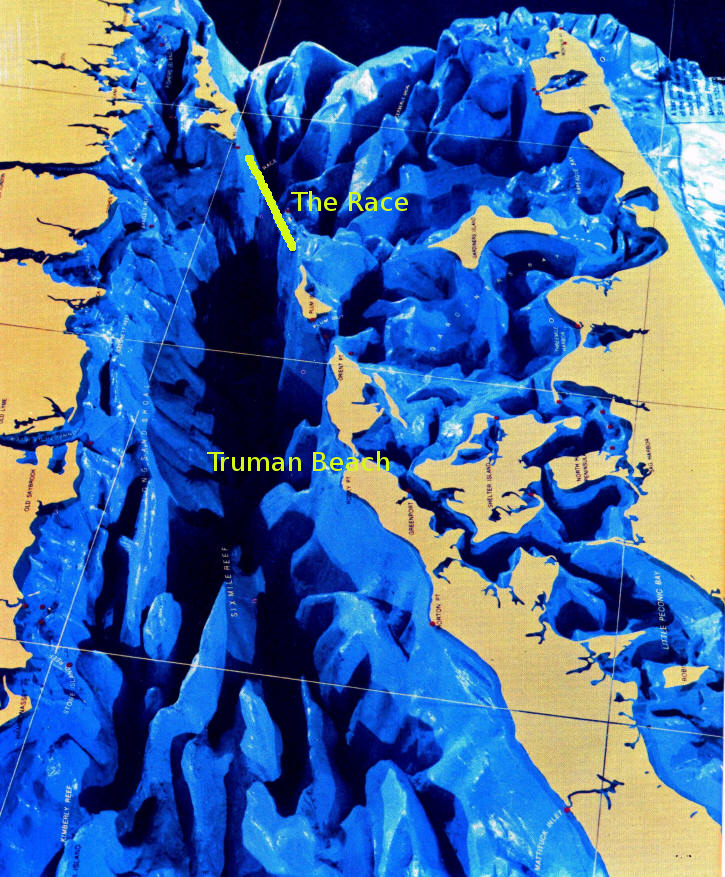
-- and found that I could get myself through The Race, the crazy tidal bottleneck at the mouth of Long Island Sound, on a vigorous ebbing current, if I got myself in gear quickly. Below, a diagram:

It's a little confusing -- east is up. The previous night's anchorage, Truman Beach, is labelled near the bottom. Click on the image to see more detail. All the water in the deep bits at the bottom of the image and beyond -- that is to say, to the west of the bottleneck, in the body of Long Island Sound -- has to empty out on the ebb through the small area shown with a line labelled "The Race". As you can see, it's narrow and relatively shallow, so the current gets quite strong.

I had had some trouble with The Race last year, coming home from Maine, and I didn't want any more. So I scrambled up on deck in my underwear and weighed anchor any old how and set out.

Eldridge was right, of course, as Eldridge always is. I went bounding through The Race like a bobsledder, wind on my port quarter, sun sparkling on the water, as sweet as you please, past Plum Island and Gull Island Light and Fisher's Island, and after a pleasant uneventful day I dropped anchor in a long slow purple twilight inside the Point Judith Harbor of Refuge.

Zoom out, as usual, to see the larger context.

How I love that phrase, Harbor of Refuge. Duncan, Duncan, Fenn and Fenn's famous Cruising Guide takes a dim view of this particular Harbor of Refuge -- a view which on the return trip I was to find justified -- but on this occasion it couldn't have been nicer.

The breakwater, admittedly, was lined with huddled seabirds, black against the dimming sky, and they had a sinister look, like ill-disposed jurymen contemplating an obviously guilty defendant. But there were a dozen other sailboats already anchored inside, their cheery little anchor lights lit at masthead or spreader, and this always gives me a good feeling.

I boiled and ate the last of my fresh eggs, drank a glass or two or six of wine, and went to sleep. The Harbor of Refuge lived up to its name, and I slept like the proverbial baby -- though come to think of it, babies in my experience don't sleep all that well. Wonder who came up with that expression?

Day 6: From Jefferson to Truman

Sailed through the night of Day Five and into the morning of Day Six: calm and clear, moon a little past full. Light wind from the southwest. This seems to be the phase of the trip -- there always is one -- when bits of poems start running through my head. Aeneid vii:


... postquam alta quierunt
aequora, tendit iter velis portumque relinquit.
Adspirant aurae in noctem nec candida cursus
Luna negat, splendet tremulo sub lumine pontus.
Proxima Circaeae raduntur litora terrae,
dives inaccessos ubi Solis filia lucos
adsiduo resonat cantu tectisque superbis
urit odoratam nocturna in lumina cedrum,
arguto tenuis percurrens pectine telas.
Hinc exaudiri gemitus iraeque leonum
vincla recusantum et sera sub nocte rudentum,
saetigerique sues atque in praesaepibus ursi
saevire ac formae magnorum ululare luporum,
quos hominum ex facie dea saeva potentibus herbis
induerat Circe in voltus ac terga ferarum.
Quae ne monstra pii paterentur talia Troes
delati in portus neu litora dira subirent,
Neptunus ventis implevit vela secundis
atque fugam dedit et praeter vada fervida vexit.

* * *

Usually I like to translate stuff myself, but it's pretty hard to improve on Dryden:


He plow'd the Tyrrhene seas with sails display'd.
From land a gentle breeze arose by night,
Serenely shone the stars, the moon was bright,
And the sea trembled with her silver light.
Now near the shelves of Circe's shores they run,
(Circe the rich, the daughter of the Sun,)
A dang'rous coast: the goddess wastes her days
In joyous songs; the rocks resound her lays:
In spinning, or the loom, she spends the night,
And cedar brands supply her father's light.
From hence were heard, rebellowing to the main,
The roars of lions that refuse the chain,
The grunts of bristled boars, and groans of bears,
And herds of howling wolves that stun the sailors' ears.
These from their caverns, at the close of night,
Fill the sad isle with horror and affright.
Darkling they mourn their fate, whom Circe's pow'r,
(That watch'd the moon and planetary hour,)
With words and wicked herbs from humankind
Had alter'd, and in brutal shapes confin'd.
Which monsters lest the Trojans' pious host
Should bear, or touch upon th' inchanted coast,
Propitious Neptune steer'd their course by night
With rising gales that sped their happy flight.
Supplied with these, they skim the sounding shore,
And hear the swelling surges vainly roar.

* * *

Splendet tremulo sub lumine pontus

... may be my very favorite tag in all of Latin verse, but

And the sea trembled with her silver light

... hits the bulls-eye, doesn't it? It's partly the "her" that does it.

Oh and by the way, how great are those odd Alexandrines that old Johnny drops in --

And herds of howling wolves that stun the sailors' ears!

At any rate I kept well clear of Circe's enchanted shore and her herds(*) of wolfish beast-men on Long Island, until the late afternoon. The wind was diminishing and my eyelids sagging and finally, faute de mieux, I anchored in a shallow little bight off the ominously-named Truman Beach, near Orient Point, the jumping-off place of Long Island:

During the night the wind backed way into the north and then west, and Truman Beach, which started out rather quiet, became a roller-coaster. I woke up once or twice during the night and checked the GPS to make sure I wasn't dragging my anchors -- I had put both of 'em down, against just such a turn of events. I wasn't, and so I wedged myself into a corner of my little stuffy vee-berth so I wouldn't roll around too much, and went back to sleep. You can sleep very well when you're really tired.

---------------

(*) Do wolves form herds? Maybe under Circe's management they do.

Day Five: Escape from Port Jefferson

Rose early, made coffee, pottered -- waiting for a call from Port Inflatables. A pleasant warm sunny morning, with little wind yet evident.

My neighbor Will was preparing to weigh anchor: He used his ingenious crane to swing his dinghy motor up and onto its bracket, and then hiked the bow of the dinghy itself well up out of the water, so only the stern was trailing. Then he fired up his engine and recovered his anchor and put-putted away out of the harbor, passing alongside the Scapegrace about 20 feet away, with a cheerful wave. "Fair winds!" he called out. I couldn't quite think of the equivalent thing to say, but finally came up with "Calm seas!"

Port Inflatables called about 10 and said the motor was ready. So I pulled up the hook and motored in to the town dock, where you can tie up for $12 an hour, a bit more reasonable than Danford's $20.

The town dock is an actual dock, not a float, and the tide rises and falls a fair distance here -- six feet, maybe more. I thought the tide was pretty much dead low, since my head as I stood on the deck of the boat was well below the level of the dock. So I tied my springlines without a whole lot of slack.

Port Inflatables showed up in their truck with my motor, and the town dock had a cart I could use to wheel it back down to the boat. But how to get it on the dinghy? The dock was probably twelve feet above the level of the water, and the only way up and down was slippery weed-covered vertical ladders.

Fortunately, the nice chap who runs the town launch offered me a place to tie up the dinghy at his float, so I could just wheel the motor down a ramp and then sit at the edge of the float and rassle the motor into the dinghy. That done, the motor started on the first pull and ran as smooth and sweet as you please. (But for how long?)

I took the opportunity to empty the porta-potty into the town dock's toilet -- I always feel a little furtive doing this, though I suppose it's OK. And I topped up my water tank, and then found that there were showers and washing machines available for town dock users, and so I went and had a long-overdue shower and did my laundry.

When I got back, I was mortified to see that the Scapegrace's mast was cocked at about a fifteen-degree angle. The tide, it seems, had fallen a good deal further, the springlines were taut as fiddlestrings, and the boat was sagging drunkenly to port.

Fortunately, Pearson built these boats very strong, back in the day, and the cleats were still firm on the deck. (Although one of the cleats on the dock had pulled away from the wood a couple of inches.) I quickly slacked off on the springlines and the boat came back upright with an audible and slightly reproachful sigh. No harm done, except to my already-fragile sense of competence.

A poem written by an old friend of mine, Bill Hedrington, came suddenly to mind:

The Boats

The boats that bump so docile at the dock
Are moored there slackly; no rowboat captain
Even, but knows the moon-called sea takes line,
And will have it, or hang the boats to break.
I’m not a boat, my will is not a rope,
And you, for all your changes and your pull
Tiding my heart’s rerunning salty well,
Are not the pumicestone that queens the deep.
Yet, I might as well be boat, and you moon,
For though I fight, my blood bends with the sea,
My body aching at my twisted will.
How, unless a man tie back the ocean,
Can taut lines help but snap, and how, once free,
Can any man but be a tide-bound hull?

* * * * *

I paid the town for my time at the dock, and almost literally sailed into the sunset.

Friday, October 2, 2009

The endless Day Four, concluded at last

Shown above is the approximate site of my anchorage on Day Four. If you use the control and zoom in, you will see an immense mooring buoy nearby, trailing massive cables visible even from outer space in the shallow Port Jefferson water. (You can also zoom out, of course, and get a sense of the geography).

My anchorage was maybe 100 or 150 feet from this monster buoy, and I hoped devoutly that no barge would be brought in to moor at it during the night, a hope which was, fortunately, fulfilled.

One gets very superstitious on a boat, and thoroughly pagan and polytheist. I'm constantly saying little prayers to wind gods and sea gods, anchor gods and outboard gods, and I'm absolutely convinced that the Scapegrace herself is entirely sentient and taking close note of what I say and how I act -- more than that: I'm convinced she can read my mind. When I swear at something -- which is frequently -- I always add a mental footnote, which I'm sure Scapegrace can hear: "That wasn't aimed at you, darlin'."

Just to be sure, I often say it out loud, too.

Once the anchor was down, I lit my goofy third-world knockoff of an old-fashioned rural kerosene lantern. (I don't like to use the electric cabin lights, particularly since my battery seems to get drained very quickly.). Below, an image -- very blurry, alas, due to the long exposure -- of the Scapegrace's cabin by lantern light:

... and I started pottering, whipping the ends of lines and so on, when I hear a voice: "Cap'n! Cap'n!"

(I love the way everybody calls you Cap'n -- or sometimes just Cap -- on the water. Everybody, that is, except the oafish thugs of the New York City police department, who demand "ID" and then call you "Mike" if they call you anything at all. But that's another story.)

This particular voice, it turned out, belonged to the skipper of a nice homey-looking modest-sized motor yacht anchored nearby. He had come round in his dinghy just to be sociable. Let's call him Will. Will invited me over to his boat for a drink, and I didn't need to be asked twice. I extinguished the lantern and piled into Will's little inflatable dinghy -- much like my own, except that the outboat was working.

We crossed the hundred feet or so of quiet water to Will's boat and spent a very pleasant hour or so exchanging observations about this harbor and that. Will was -- is? -- a librarian in a Connecticut town, and if I understood him correctly, he was making a circumnavigation of Long Island, and was going to pick up his wife in a day or two, somewhere in Connecticut, to make the next stage or two of the journey together. He used to have a sailboat, but now has the "trawler" -- as many motorboat guys seem to be calling their boats these days -- because, let's face it, it's just so much easier.

I could see his point. He had more space on his boat than I've had in some of the apartments where I've lived. He had an ingenious little crane which enabled him to pluck the outboat off his dinghy and clamp it to a wooden block on his stern rail, which of course makes the dinghy tow a lot more easily.

We sat on lawn chairs -- lawn chairs! -- on the afterdeck and sipped thoughtfully at complicated drinks Will had made. There was whisky in them, but I couldn't tell you what else, nor do I remember what they were called. Rusty Scuppers? Sacrificial Anodes? Something nautical-sounding, as I recall.

Finally we both started to yawn. Will gave me a lift back to the Scapegrace, where I soft-boiled a half-dozen eggs -- not having eaten anything all day -- and ate them ravenously with the last of a not-so-fresh baguette, and then tumbled into my sleeping bag and slept very very well indeed.

Thursday, October 1, 2009

Day Four, continued: outboard adventures in Port Jefferson

Kinda left the narrative thread hanging there, didn't I?

When last heard from I was motoring to Danford's Marina in Port Jefferson, shown below:

The marina is in the center of the map; the ferry slip, for the Bridgeport-Port Jefferson car- and people-ferry, is a bit to the left. Unless Google have changed the satellite image by the time you read this, you can see a ferryboat actually approaching the slip. I may have a bit more to say about this ferry later.

This image must have been taken during the off-season; as I approached, there were a lot more boats around than you see here, and many of them were big intimidating boats, including the doltishly-named Prediction, mentioned in a previous post, a boat larger than many New York apartment buildings. If it had been there when this photo was taken, we might have had to back off on the zoom.

My goal was to get the outboard on the dinghy fixed -- for the third time this summer. Danford's is supposed to do repairs, and a breezy young lady had assured me on the cell phone that such was indeed the case.

Once I tied up at Danford's dock -- for which one is charged $20 an hour, a fee I shamelessly skipped out on later, and without permission, too -- the mechanic turned out to be a pleasant young man, let's call him Lycon, who enjoys tinkering with outboards. He and a couple of dockside sages confirmed what I already knew: the carburetor was gummed up and would have to be taken apart and cleaned.

Lycon wasn't quite ready to undertake this task, though I think he might have made a good job of it. But he knew just who to call: Port Inflatables, specializing in inflatable boats like my dinghy, and small outboards like the one that powers it.

Port Inflatables was willing to send a truck to pick up the outboard, though they wouldn't venture out onto Danford's dock. I got the impression that Danford's could be rather stroppy about other people trespassing onto their turf. So I had to rassle the outboard out of the dinghy -- a sweaty effortful business -- and then up Danford's dock and across Danford's parking lot and out to the sidewalk, which took a good deal more sweat and effort. Outboards, even Japanese outboards made of aluminum foil and sushi, are heavy, and awkwardly shaped to boot.

Port Inflatables showed up promptly, as promised, in their truck, and took the poor outboard into their care. They made a good efficient impression. "We'll call you tomorrow," Inflatables said.

I could hardly have expected better -- this was mid-afternoon, or perhaps a little later -- but even so, the line had an ominous ring: I'll see you when I see you. Don't call us, we'll call you.

But what can't be cured must be endured. So I resolved to use my time ashore well. I asked where I could find a grocery store. Blank stares all round, which became blanker still when I mentioned that I would be on foot.

The nice people who work at Danford's don't live anywhere nearby, it turns out. They live in Five Towns or Massapequa or Huntington Bay and drive fifty miles each way to their jobs, and they never, ever walk around on the streets of Port Jefferson.

Finally someone dredged up a memory of a convenience store, owned and staffed by hard-working entrepreneurs from the Indian subcontinent, a ways up Main Street, which runs away from the waterfront and climbs a rather steep slope to the bluffs behind the town. Thither I set off.

Now I haven't really set the scene very well here. It's a hot, sunny, still day. I've been tinkering with the motor, and then humping it off the dinghy and up the dock, and at this moment I'm trudging up furnace-like Main Street with Long Islanders' SUVs blasting past me and blowing exhaust in my face, and I'm starting to feel a little strung-out and a little parched.

When what to my wondering eyes should appear, but --

A cool, shady, caravanserai whose actual name I forget; but let's say it was something like Captain Jack's Bar and Grill.

Some bars appeal and some don't. This one appealed very strongly. Its entire front was open to the street, but set back from it, across a sort of terrace, and you could see the folks sitting at the bar, well inside and out of the sun, and other folks sitting at tables, and they all seemed to have tall frosty steins of beer in front of them, which my usually hazy old eyes registered with preternatural aquiline clarity.

This is the place for me, I thought.

By this time I'm scruffy, not having shaved or showered in four days, and sweaty, and thoroughly disreputable looking, and there can be no possible doubt that I smell like an old plough-horse. But I sat myself down at the bar and pulled a book out of my pocket -- I never go anywhere without a book, and reading a book makes you less alarming when your grooming is not what it should be. And the sweet young thing behind the bar came over and I ordered one of those frosty steins of beer I had seen from the street.

The sweet young thing -- let's call her Phyllis -- produced my frosty stein with admirable alacrity, and then to my utter amazement engaged me in conversation.

She's maybe twenty, and I'm sixty-plus and looking every minute of it. and surely as far as she is concerned I might as well be a dinosaur skeleton in the Museum of Natural History. But she took an interest in my journey, and plied me with questions, and even wanted to know what I did about sanitation on the boat, and wasn't grossed-out by the porta-potty.

Dear reader, perhaps you have a suspicious turn of mind. If so, let me reassure you: I do not flatter myself that Phyllis was coming on to me.

You're out on the water for a few days, and you start to have wild fantasies. In my slightly crazed Jack-ashore mood, I would have loved to think that Phyllis couldn't resist my threadbare charms, but it just obviously wasn't that kind of conversation. What was amazing me was her unusual curiosity and her openness.

Long Island is a very suburban place -- perhaps the most suburban place there is -- and suburban life is so impoverished, so limited, so narrow, so contrived and controlled, that its offspring usually end up somewhat atrophied. They don't understand any dimension of social or personal existence that they haven't already encountered in high school -- don't understand it, and don't want to hear about it. You mention anything they haven't seen on YouTube, or been told about by some slightly cooler coeval, and you get the Suburban Blank Stare.

But Phyllis wasn't like that. She didn't seem to be chafing at her circumstances, and longing to get over the wall. She was very much of her milieu as well as in it. But somehow she had escaped the lobotomy. She was quite keen to hear about the adventures of an eccentric, oddly-spoken and ill-groomed old man from New York, who blew into town on a far-from-fancy old boat and obviously doesn't have a pot to pee in, money-wise.

I can't tell you how much this cheered me up.

I had a second beer and then reluctantly left Phyllis to whatever life has in store for her -- and I hope it's something very nice indeed. I trudged up the hill, in the slightly cooler crepuscule, and found the Subcontinentals and bought a few necessities including some ice for the cooler, and trudged back to Danford's dock and, as already confessed, left without paying their robber-baron tariff and went to look for an anchorage out in the bay.

This entry is way too long already, and Day Four isn't even over.

That's because this was a turning point. I haven't really come clean about how I was feeling.

The dinghy motor failure -- third this summer! -- had convinced me I was cursed, numine laeso, hopeless. I was ready to take the boat back to New York and take the train to Maine.

Then I found Inflatables, or rather, Lycon found Inflatables for me. Inflatables gave me, on balance, a good feeling, and hey, it's only money. Then Phyllis made me start to think that what I had undertaken was worth doing and worth telling about, and most of all, a cell-phone conversation with my indescribably wonderful wife gave me a shot in the arm -- as she always does.

So I will suspend Day Four again as I putt-putt out onto the quiet shadowy waters, seeking a place to spend the night, a place that I don't have to pay for. The coming of the light today found me very dark, and now that it's dark, I'm feeling lighter again.

Wednesday, September 30, 2009

Day Four, continued: Boat names

Danford's Marina is a large rather flashy but obviously well-run place frequented by some very big and expensive boats. There was a motor cruiser tied up there so vast that it figured in the dockmaster's directions: Come into the harbor until you get to the Prediction and then go left....

"Prediction" is an awfully dull and uninspired name for a boat, isn't it? Some tens of millions must have been spent on this monster, which was the size of a middling warship -- and they couldn't come up with a better name? I couldn't help thinking that it was probably owned by some hedge-fund creep and the name celebrated this parasite's prowess at anticipating the market. (Let's hope it was the previous owner's previous prowess, and that the self-celebrator is now living a lot less large.)

This got me thinking about boat names.

They fall into several categories. There are girls' names innumerable: Mary Ann, Rosalind, Geraldine, and every other name a female human being ever bore. (Well, maybe not Hrotswitha.) There is the clumsily jocular, a numerous category: Buona For Tuna and the like. There's the name you come up with because you can't think of a name: Come Si Chiami [sic], another boat in Port Jefferson. There's the name that advertises your ancestry: Cill Dara, though I think this one may have been spelled with a 'K'. There's the grandiose -- Astraea, with a rendering of the Pleiades on the sail.

There's the slightly wistful -- Serenity (very frequently encountered, this -- there are two of them at the 79th Street boat basin); Daddy's Toy; Magic Hour. Sailing, in my experience, doesn't really live up to these expectations, though it has its charm; and Daddy's Toy, in particular, was last seen half-sunk and sadly uncared-for in Eastchester Bay.

There's the original -- Ishtar and Hambo, and there's the slightly ill-omened -- Palinuro; what were they thinking of? And there's the enigmatic -- Pitchi Poï, seen in New Rochelle.

This last, a little Googling shows, is a Yiddish phrase, though I can't find either word in Weinreich's dictionary, perhaps because I can't correctly reverse-engineer the Yiddish spelling from the transliteration. But I gather it's a phrase with not entirely happy associations. So why did somebody name his boat that, and render the name in whimsical humorous lettering, which I wish I had taken a picture of?

I might have asked, if I had seen Pitchi Poï's skipper. But I probably wouldn't have. I'm rather shy about approaching other sailors. Or other people in general, actually. Fortunately this is not true of all the other sailors out there, and so some agreeable encounters occur in spite of one's own shyness. I experienced just such an encounter later on today, Day Four; but that, and the saga of the dinghy outboard, will have to wait yet again.

Tuesday, September 29, 2009

Day Four: Sing, Muse, the woe of outboards

Spent a quiet night at anchor off Old Field Point, near Port Jefferson, shown below:

Awoke with the birdies on Day Four and wanted to take the dinghy, for some reason, and go into Port Jefferson. Needed gas, maybe? Can't recall. So I climbed down into the dinghy and released the ugly improvised lashing on the motor -- I lost a motor off this dinghy once, a story I may tell someday, and don't want to lose another -- and popped it down into the water and squeezed the little bulb on the fuel line and cranked and cranked....

It wouldn't start.

Now this motor and I have a history. It's a little Tohatsu four-stroke four-hp bijou of a thing. I bought it from a guy -- a guy on Long Island, now that I think of it -- after its predecessor was lost, as mentioned above. It was practically brand new: clean, pristine, all that. He had bought it and decided he needed more than four horsepower. It came with a tank and hose.

In retrospect, I think he must have left it standing around for a while -- who knows how long? -- with gas in the motor and tank and hose, and gummed up the works to a fare-thee-well. At any rate, from the day I bought it, it had been nothing but trouble. I had already had it in the shop twice this season to have the carburetor dissected -- an expensive hobby. Now here it was, dead again.

The second time I had in in for surgery, with Maureen the Outboard Queen of City Island, she sold me a new fuel filter and told me to be sure to put it in. Of course I had not done this. So with a sinking feeling that I was closing the proverbial barn door after the proverbial stolen horse, I changed it out on the water of Long Island Sound.

Which took forever. This motor is so intricately and compactly put together, with fiendish origami ingenuity, that it's like eating a lobster to get at any part of it. To reach the fuel filter you have to remove the little integral fuel tank, attached in three places with a highly refined arrangement of spacers, rubber washers (to prevent vibration, I suppose), nuts and bolts and little L-shaped clamps and lockwashers -- twenty or so different parts just to secure this schmoo-shaped little plastic tank.

Needless to say I dropped three or four of these parts in the water. You remove a bolt and don't realize that down where you can't see it, that bolt is holding something else on. It's like the ancient joke about the man with the golden screw head in his navel: when he finally unscrewed it, his ass fell off.

At last I got the filter changed and the motor put back together. It still wouldn't start.

My cruising guide told me that Danford's Marina, in Port Jefferson, did repairs. I called 'em up on the cell phone and they said, sure, bring 'er in. So I motored the Scapegrace, towing the poor dinghy, into Port Jefferson harbor and up to Danford's dock.

To be continued....

Sunday, September 27, 2009

Day Three: Intermezzo

Dawn of Day Three came up like thunder....

No, it didn't. It came up like a semi-trailer cresting a rise on an interstate highway, over the godforsaken blighted accursed Robert Moses-haunted sad spoiled landscape of Long Island. And in due course its busy old beams peeped into the cabin of the Scapegrace and fell on my sleepy eyelids and I slowly, reluctantly, roused myself and poked my head abovedecks and took stock of my situation.

I was still miles from shore and a few miles further toward my destination and had a hundred feet of water under my keel, all to the good. The air was clear and the breeze mild and the seas calm -- quite a contrast from the lively night before. I made some coffee and then freed the tiller from its lashings and let the jib come over to starboard and then I sailed for a while. In fact I sailed most of the day, not very fast.

Truth to tell, I don't remember a thing about this day, after that first matin observance. I probably listened to the radio a bit, and no doubt gobbled some raisins and peanuts, and may have made a call or two on my cell phone. But it's a lost day -- which probably means it was a good day.

That afternoon I anchored off Old Field Point, just west of Port Jefferson, and spent the night riding calmly at anchor.

Saturday, September 26, 2009

Day 2, continued: A wild night

Wind came back into the west in the late afternoon, so I pulled up the anchor and headed out.

The weather radio said short thunderstorms were "possible", and about an hour later it turned out this was understated. A black blinding squall, with rain falling in streams rather than drops, came roaring across the water like an express train and hit me a lot quicker and harder than I expected.

I was able to heave-to and reef the mainsail and partway furl the jib (thanks to the handy roller furler) and by the time I got that done the storm was over, the sky was clear, the wet decks were gleaming-clean and the little droplets of water hanging here and there sparkling like sequins in the horizontal light of the setting sun. Oh and the wind was a nice steady ten knots, a little north of west, and the seas were maybe two feet and leisurely.

This halcyon state of wind and sea persisted until nearly midnight. Then the wind got stronger and the water very choppy, hitting me pretty hard on the port bow and making it hard to keep my course. And I was tired: had gotten up in New Rochelle quite early -- for me -- and had been either sailing or hull-diving all day. I just don't have the dura-ilia for these 24-hour forced marches any more.

So I hove-to on the starboard tack about four or five miles from the Long Island shore. Went below and pottered a bit, trying to warm up. Then noticed that the GPS was telling me I was actually traveling a knot or so in the diametrical wrong direction: west, that is, back toward New York. My fuddled brain gnawed on this bit of data for a lot longer than it should have had to and then the penny dropped: if I heave to on the port tack instead I'll reverse my direction of travel by 180° and be making progress without having to do any work!

The half-tack required to get me there was a bit white-knuckle since the sea had come up a good deal and the wind was, shall we say, brisk. As I gathered way for the tack the swells were coming across my starboard quarter. The Scapegrace gets very skittish and playful under those conditions and I was slow and groggy. It took several tries: coming up into the wind almost almost almost getting the jib back-winded and then, bang, a wave knocks the bow back and it's all to do over again: fall off, gather way, put the helm down, mutter come on, come on... and then another damn wave. But finally I caught a break or the wave gods tired of toying with me and the bow came round as sweet as you please and I lashed the tiller and went below and fell sound asleep in the middle of Long Island Sound.

Well, not quite the middle, of course. I was pretty much on a line between Eatons Neck and Port Jefferson, on the threshold of the bight between them. If I can get the Google Maps api to play nice with Google Blogger -- which is not so easy as it ought to be -- a map will appear below:

So I was out of the shipping lanes. But still I suppose there's stuff to bump into, or be bumped by. As it happened no such disaster befell and I slept the sleep of the bone-tired until dawn -- which brings us to Day Three.

Friday, September 25, 2009

Maine-bound, day 2: Through the gut of Long Island Sound

Awoke early in New Rochelle. Made a sincere attempt to find the harbormaster, but didn't see him; so as he suggested last night, I "forgot about" what I owed the fine city of New Rochelle for my transient slip, and put-putted out of the harbor.

A nicer day than yesterday: sunny and warm, with a promising breeze from the west. But as the day wore on it veered north, and then easterly, and pretty soon it was dead foul. So I put in to the mouth -- just behind the lips, really -- of Huntington Bay, and anchored west of Eaton's neck in 20 feet of water, just sheltered by the land. Not a real harbor at all, just a spot to stop for a few hours.

My depth gauge has been giving me funny unreliable info for a while, and I have speculated that maybe so much algae has grown on the bottom that the transducer is unable to get a signal out, or back, or whatever. So I stripped and put on the face mask and the fins and dropped the little rope swim ladder over the side and went down under the hull with a plastic Brillo pad to clean the transducer.

First time I've swum off the boat since I've owned it. I remember these waters well, from windsurfing here twenty years and one marriage ago. Warm -- soupy, even, in August -- and a little cloudy. My crewman-to-be, Ishmael, thinks this is because all the septic tanks and fertilized lawns of Long Island drain into the Sound and eutrophicate it, and the theory seems plausible. Also, of course, Huntington Bay is quite shallow and heats up nicely during the summer.

The algae theory abut the depth gauge had a lot to recommend it. The hull was shockingly overgrown. Isn't the poisonous bottom paint supposed to prevent this? Or is that just barnacles? The keel looked like one of those fur-hatted Hasidim in Williamsburg -- luxuriantly hirsute, trailing tendrils and fringes and skirts and lappets of sea-hair every which way.

I haven't been under water much, recently, and found I couldn't hold my breath for very long. But after half a dozen quick dives I had cleaned off the transducer pretty well. Time to get back into the boat.

This, it turns out, is not so easy. The swim ladder is not a rigid metal one; it's made from rope. And like an idiot, I've hung it off the bow, which falls away at a sharp inward angle. So as I try to climb the ladder, it swings inward toward the hull and away from me, and I'm hanging backwards like a tree sloth, trying to pull myself hand-over-hand up the rope like a kid in boot camp.

Which I am not.

After much ungraceful scrambling and the usual quantum of swearing, I made it back on deck, bone-tired as I always am these days after any modest exertion. Lay on the deck to dry off in the late afternoon sun and the mild warm breeze, which felt very nice indeed. Then boiled some eggs, and tried to go to sleep -- unsuccessfully, as the sequel will show.

Day 1, continued. The backside of America

New Rochelle has a sweet funky municipal marina, with buildings in that cool Thirties ocean-liner style. (Of course I forgot to take a picture, which will also be a recurring theme here.) There is a restaurant in the marina, and I decided to go have dinner there.

This project proved more difficult than you might expect. I couldn't find the entrance. I could see the windows of the dining room on the second floor, facing out onto the water, but there was no stairway up to it, and no door. I walked around to the street side of the restaurant, which turned out to be a blank wall with a small door -- obviously a service entrance to the kitchen -- where several busboys were lounging and smoking cigarettes and conversing in languid drawling Portuguese.

Finally, after about 20 minutes of fruitless prowling around the perimeter, the light dawned. There is an elevated parking garage next to the restaurant. Another trip back to the street and then down the ramp into the garage and voila, an awning and a double door and a sign and a board with the day's specials.

Moral: If you want to find the front of anything in America, pretend you're a car.

The water side of the restaurant -- and this is true of most waterfront structures in America -- presents a gaze but not a face. It is a place intended to be seen from, not to be seen or approached. It has no expression, no iconography, it makes no sign to you, conveys no message of welcome or grandeur or menace. It is not expecting you to be there, and you always catch it unawares -- en déshabillé, so to speak.

As for the actual street frontage -- since the building is right on the street, there's no room for a parking lot in between. Now the public face of any American building must give onto a parking lot. This is literally the law. You will approach in a car. You will no more approach on foot than you will approach in a boat.

There are alternatives. Here's Dublin:

Here's Venice:

From a boat, as from a train, you see the backside of America, in all its unsuspecting bare-assedness.

Thursday, September 24, 2009

Maine-bound, Day 1: Escape from New York

Caught the ebb tide from my mooring on the Hudson at 11 pm, an hour after slack water. My mooring buoy is semi-submerged, and absolutely submerged when the current is strong, bounding around three or four feet underwater like a Rhinemaiden on methedrine. Left a note for Joe the harbormaster and buoyed the mooring lines so I could pick them up more easily (we shall see what became of that ingenious scheme).

Had to motor down the Hudson -- wind versus current, bumpy and disagreeable -- in that weird still wee-hours world, when the city isn't asleep but it's a little groggy and its eyelids are half-shut.

So much light. A big fish jumped out of the water and splashed back with a startling explosive noise and nearly startled me out of my skin.

Naturally the southerly wind died as soon as I rounded the Battery, so I also had to motor up the East River. Got through Hell Gate without any hair-raising encounters with barge traffic -- a first, actually -- at about 3 AM.

I've always loved the Hell Gate railway bridge:

There was a passenger train going across it as I approached. It looked like the Polar Express in the Chris van Allsburg book -- all lit-up with warm yellowish lights shining from the windows, snug and cozy-looking, the headlight from the engine illuminating the girders of the bridge from the sides and below, an angle of lighting you never see otherwise. Very beautiful, very poignant and evocative, I couldn't tell you why. Not just a mechanical vehicle passing over a dead piece of architecture -- more like the intertwined bone and sinew of some vast living thing.

Got to sail a bit after the Triborough -- if I ever call it the RFK Bridge, may all the gods simultaneously strike me dead -- and tacked twice between the Whitestone and Throgs Neck. Then the wind died and a grim steady cold depressing rain settled in, like Noah's flood come again, and I ran into dear old familiar New Rochelle and begged a transient slip off the harbormaster.

"Shall I settle up now?" I asked.

"Naah, tomorrow morning," said the harbormaster.

"I might be leaving early -- maybe I won't see you."

"If I don't see you, forget about it."

I love Boat Dudes. This will be a persistent theme.

Wednesday, September 23, 2009

Back on the grid

Not to give the ending away, or anything, but I made it to Maine, and I made it back. I'll post a day-by-day account of the saga, in all its low-mimetic comedy, starting tomorrow.