Saturday, October 17, 2009

Day 14: Farewell to Cape Cod

Normally I love to sleep late. But I had a looming deadline. My family were going to show up in Maine in just a few days, and I had already spent two weeks creeping along the coast. I was eager to get under way, and so I woke -- uncharacteristically -- at dawn on Day 14.

Ishamel and I had discussed my battery problem the previous evening. I haven't mentioned it before. The problem was that the navigation lights wouldn't burn all night on battery power. Was the battery bad? Was the motor not charging it up properly when it ran?

Ishmael and I were both inclined to blame the battery, and we had mooted the idea of going back into Provincetown in the morning -- there is a great and well-stocked chandlery there -- and buying a new battery. (Hey, it's only money).

I was tempted, but I also wanted to get going. So while Ishmael slept -- and he snores like a buzz-saw, let me tell you -- I quietly made my coffee, and recovered the anchors, and made our escape from Provincetown.

The Pilgrim Monument was just a nick on the horizon when Ishmael awoke. He took the helm while I made some more coffee, and then like a stalwart fellow he kept the helm through a very lively day, crossing Massachusetts Bay from Provincetown to Cape Ann:

The wind was brisk, from the north-northeast, and we were quite close-hauled to weather Cape Ann. A stiff sharp swell had built up, sending spray over our bow with each sea. But Ishmael has a light steady hand on the helm, and kept us going where we were supposed to go, and seemed to be enjoying himself, so I very gratefully left him to it. I updated the log and pottered away in the cabin -- there is always something to do, on a boat. This observation may already have been made.

About midday we sighted some whales, maybe a half-mile or so away, leaping out of the water and blowing spectacular brilliant white plumes of vapor. Ishmael knows one whale from another, but we were too far away for him to discern what class of whales these were -- but he sus[ected humpbacks. I had never seen whales before, on the water, so this was a red-letter day for me.

As afternoon drew into evening, the wind diminished and the sea became more calm. We soon realized that we weren't going to weather Cape Ann on the starboard tack we'd been on all day, so we decided to anchor somewhere on the south side of the cape.

The place we finally found was a little shallow cove off Emerson Point:

It wasn't a great anchorage -- looked better on the chart than it proved to be in fact. Sheltered only from due north, rocky, narrow. We came in a little close to some nasty-looking rocks just barely submerged, then dropped one anchor and spent the usual fretful ten minutes backing down that anchor line, into deeper water a bit farther from the rocks, before dropping the other.

We drank some of my crummy boat wine and, though I didn't make a note of it at the time, I believe we cooked something to eat. We must have had some fresh food -- I remember that we got a new supply of ice for the cooler in Wellfleet.

Being an old Southern boy, I never feel quite at home unless there's an old grungy blackened cast-iron frying pan somewhere close at hand, and so I have one aboard the Scapegrace:

I think we deployed this household god for dinner, though what we cooked in it is anybody's guess. I'll ask Ishmael next time I see him. Perhaps he will remember. It vexes me when something like this gets lost: the details are everything.

Ishmael's plan was to accompany me all the way to Maine. But after dinner, he got a cell phone call. Family crisis. Cousin in a jam down South. Ishmael wondered whether he needed to cut his sail short and go help out. We kicked the question around inconclusively for half an hour or so, then agreed that we were both dead tired and should defer the matter till tomorrow morning -- there was nothing to be done tonight in any case.

I raised my improvised little anchor light and we turned in.

Friday, October 16, 2009

Day 13: from frustration to fabulosity

Day 13 dawned clear off Barnstable, but there wasn't much wind, and what there was came from the north-northwest. I was pessimistic about getting anywhere, and resigned to spending the day exploring yet another unplanned-for harbor, namely Barnstable. But Ishmael was keen to forge ahead, even if it meant beating tack upon tack up Cape Cod Bay. After all, with two of us, it wouldn't be so difficult. His enthusiasm proved contagious and so we weighed anchor and set off.

Our faith -- well, Ishmael's faith -- was quickly rewarded by a strengthening breeze that also conveniently backed into the west, so we scooted up Cape Cod Bay uneventfully at four knots or so and came coasting into Provincetown harbor and anchored just after dark.

Provincetown is an interesting place. The structure shown above is the Pilgrim Memorial, and if it reminds you a bit of the Palazzo della Signoria in Florence, it should -- the latter is below:

Who, I wonder, thought that a knockoff of a mediaeval Italian building, from a time and place steeped in Popery, would be a suitable memorial to the Pilgrims? If any Pilgrim shades should revisit the town, just to check up -- what would they think of this oddball tribute?

They might not be too concerned. They would have other things to scratch their ectoplasmic round heads over. Shopfronts in Provincetown frequently display merchandise like this:

... and there was a very buff chap in the street, wearing a maillot bathing suit and promoting a show by a group called "The Nellies". "You'll eat it right down to the stick!" he promised.

It was kinda nice -- like being back in New York, though not on the upper West Side.

Thursday, October 15, 2009

Day 12-13: Pea soup

Ishmael called me around 10 PM. The fog had gathered, wooly and thick, and the air was so wet you couldn't tell whether it was raining or not. There was a barely-perceptible wind, but it was next to impossible to steer -- no reference point except the compass, and in light air the boat takes five minutes to respond to the helm. I relieved Ishmael and he went into the cabin and collapsed in his turn.

I fiddled with the radio and found a religious station, with a preacher engaged in earnest exegesis of the Epistle to the Romans. He had actually read the book and done some hard serious thinking about a hard dense obscure contradictory text. This is a undertaking I admire deeply, and have done a bit of, in my day.

My man knew his Greek, too, and though preachers usually make me groan when they start talking about the "original Greek" or the "original Hebrew", this chap got it right. So I followed his reasoning with pleasure and respect until the aether stopped cooperating and I lost his signal. I don't know quite where he would have ended up, but I was right there with him for a rather intensely focused half hour, which is longer than I can usually stay with NPR before I snort or chortle or say, right out loud, "Thou fool!"

By the time the radio preacher went away, the wind had gone away too. The Scapegrace was, for all practical purposes, adrift -- and so, of course, was I, without my radio preacher to guide me; but I'm used to that. I take my guidance where, and when, I find it.

The wind was more often out of the west than anywhere else, but you couldn't do a damn thing with it. So around midnight I hove-to against what wind there was and went and took a nap.

By 2 AM or so we had drifted almost back to Sesuit, but the wind had come up a bit, and the air was a little less thick, so I popped my bleary head abovedecks and set sail. By 4 AM we had won our way back out of the corner-pocket of Cape Cod Bay to the vicinity of Barnstable, where the wind failed us again. In the faint chalky pre-dawn light I dropped the hook, in twenty feet of water, and went to sleep.

Wednesday, October 14, 2009

Day Twelve: tedium and terror

There's an old military aphorism to the effect that war is long intervals of tedium interspersed with moments of pure terror. Sailing is a bit like that too. Ishmael and I had our terror early on, as we were leaving Wellfleet harbor.

Wellfleet has a narrow, twisty, but well-buoyed channel, which leads you on a nice conservative course around various obstacles. The trouble is that the buoyed channel leads you the long way around, to the south, and Ishmael and I were quite keen to head north. So we decided to take a shortcut, over what used to be Billingsgate Island and is now a sandbar, exposed only at dead low tide. The Scapegrace only draws four feet of water, and though we hadn't really consulted the tide table -- well, to be honest, we hadn't consulted it at all -- we figured Billingsgate was well submerged. You can see it on the map below, a sinister blur of grey, like a tumor on an MRI:

You can probably see where this is going. It's late afternoon, the sky is overcast, the light has that peculiar coppery color. But then the light gets more and more yellow, the little wavelets just that bit more steep, and Ishamel and I simultaneously decide to check the depth gauge:

6.5 ... 6... 5... 4.5... 4...

... and then there's a gruesome grinding sound, like that noise when they're cleaning your teeth, except four octaves lower, coming right up through hull and deck and shinbones into your very bowels. I look over the side and there's the sand, clearly visible through barely four feet of water, racing along under our keel and grating against it with every little hummock or hillock.

Reader, I hate to boast, but I must say, to my own credit, that I kept my composure. Normally the idea of going aground absolutely unhinges me. But Ishmael is an experienced sailor, so I wasn't on my own. The ground was soft sand, not rock. The nice deep channel that we should have stayed in was maybe a hundred yards away, so if we had to kedge off(*), we could.

As it turned out, after a few more of those horrific gratings and grindings, the depth gauge started to tell a more cheerful story:

5... 5.5... 7... 9... 10.... 17... 25!

We were back in the channel, and from thenceforth followed the buoys with Pharisaic zeal, until we were well out in the bay and even your anxious old Granny would have turned off the depth gauge.

Night fell -- as it is wont to do, every twenty-four hours or so -- and we set a course for Provincetown. Ishamel took the watch and I went down into the vee-berth and collapsed.

--------------

(*) Kedge off. You take the anchor in the dinghy and drop it in deeper water at the very end of the anchor line. Then you pull pull pull on the anchor line and with luck, you drag yourself and the boat out into the deeper water. The one time I have had to do this, it actually worked.

Day 12: Into the fog

Ishmael and I spent the first part of Day Twelve running errands: seeking butane tanks for my little gas stove -- they're not as easily found as you might think -- and trying to find a hand drill. I have a battery-operated drill but of course I left the battery on the charger at home when I set sail and anyway, who wants to depend on a battery?

I remember old hand drills from back in the day. I don't mean a downright mediaeval brace-and-bit, like this --

This sort of thing is for people doing high-end cabinetry, or building harpsichords. No, I had in mind a sturdy old pre-electric eggbeater drill, like every home handyman used to have in his garage:

Ishamel and I must have gone to six or seven hardware stores and drew a blank on every one. Finally, at the Tru-Valu in Orleans, Massachusetts -- a store I recommend without reservation to one and all -- we hit the jackpot: more butane cylinders than I could burn in a lifetime of cruising, and a wonderfully earnest clunky heavy Chinese knockoff of the old eggbeater drill.

Some years ago I went looking for a hand plane -- you know what I mean:

... and the best I could do in my local upper west side hardware store was the same kind of slightly approximate imitation of a generations-old First World product. The plane came from India.

I plan to keep the Chinese drill on the boat and the Indian plane at home, lest they fall to quarreling over Tibet.

Ishmael took his van into the garage in Wellfleet, where it lives during the winter, and I sailed the Scapegrace from Sesuit into Wellfeleet harbor, and we set off for Down East in the afternoon.

Day Twelve is not quite over, but I'll leave the rest of it for another entry.

Tuesday, October 13, 2009

Day Eleven: Jack ashore

After my morning coffee in my tranquil slip in Sesuit Harbor, I was able to raise Ishmael on my increasingly squirrelly cell phone. We arranged for him to come from Wellfleet and pick me up.

I was a wee bit worried about this. I know Ishmael from a rather egalitarian setting in New York, and I didn't know what his place in Wellfleet would be like, or how he would feel about putting my smelly greasy gas tanks in his trunk to go fill them up. Will it be a gleaming Lexus, I wondered?

He turned up in an ancient rattletrap van full of unidentifiable junk even greasier than my gas tanks, with holes in the floor and doors held on with string -- well, maybe I'm exaggerating a bit. But let's just say my fears regarding the immaculate Lexus were laid to rest.

I had never before set foot on Cape Cod, and I took in the landscape with great interest as we drove back to Wellfleet from Sesuit -- a longer drive than I had expected. I had my nose out the window like some goofy Irish setter, sniffing the air and eyeing the older buildings for subtle differences from the New England vernacular architecture I'm used to.

The landscape is not unlike what the north shore of Long Island must have been before it got so crapped-up, but it's just that little bit farther north, so the trees are slightly gnarlier and the air slightly brisker and there's more of a piney-woods scent in it.

Ishmael's place is the canonical beach house, though it's not actually on the beach. It even has that wonderful thing, an outdoor shower.

Ishmael had some work to do closing up the house, so I tried to lend a hand. I even spent an amazingly sweaty hour or so digging potatoes and onions out of the garden, which reminded me what backbreaking work agriculture is and has always been. Once the potatoes were dug I was very glad to have the outdoor shower.

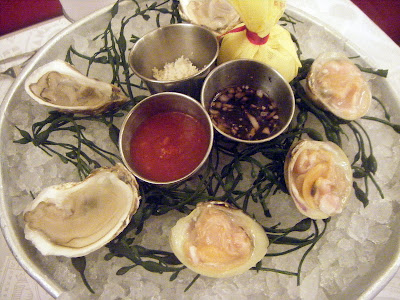
We ate raw clams freshly-dug somewhere nearby.

Now being an old Southern boy, and only an adopted denizen of the Northeast, I am usually a bit squeamish about uncooked molluscs. But these were utterly delicious, and after bravely slugging down my first one, just to be polite, I had another and another and another... I probably put on more hot sauce than a Real Man would have done, but still: now I know what the fuss is about.

Slept that night at Ishmael's place, first night I've spent ashore since I set off.

Sunday, October 11, 2009

Day 11: Ashore on Cape Cod

The monument above -- made of first-class, small-grained dark granite -- commemorates a visitor to Sesuit even more exotic than I was: a manatee, who apparently blundered somehow into the chilly waters of Cape Cod bay last year, causing a local sensation.

Dennis -- as the poor lost critter came to be called, after the town Sesuit is part of -- was duly rescued by a consortium of animal lovers, bundled onto a truck, and driven back to Florida. Alas, he died as soon as he got there.

Not surprising, really -- Florida is where lots of folks go to die.

One wonders whether Dennis would have preferred to die in the water, and not on a truck. I personally would not like to die on a truck, though it seems like tempting fate to say that I would rather die on the water.

I would rather not die at all, actually, thank you very much. Sea gods please take note.

One also wonders whether Dennis really blundered. Was he in fact the Columbus, the Captain Cook, the Henry Hudson of manatees? Do the manatees tell tales, around the ruined kelp beds of Florida, of a great warm sunny bay, with abundant algae and no motorboats, that lies just beyond the chilly ordeal of the northern waters? Were one but bold enough, one might find it. Did Dennis go to seek it? Did three little manatees cheer him on, like a manatee Tamino, with music by some manatee Mozart?

Zum Ziele führt dich diese Bahn,
Doch mußt du, Jüngling, männlich siegen.
Drum höre unsre Lehre an:
Sey standhaft, duldsam, und verschwiegen!

Dies kund zu thun, steht uns nicht an --
Sey standhaft, duldsam, und verschwiegen.
Bedenke dies; sei Manatee -- 
Dann Jüngling wirst du männlich siegen.    
Sorry, but I can't bring myself to print any of the translations I can find of this shivers-down-your-spine bit of Die Zauberflote. The metrical translations are incredibly dismal, and the prose translations lose all connection with the music. I bet Auden's was nice, but I haven't been able to turn it up on the web. Help me out here, somebody.

Here's to Dennis the Manatee, a fellow-mammal, and another crazy venturer into waters where he didn't belong. Sit levis tibi abyssus.

Friday, October 9, 2009

Day 10: Through the armpit of Cape Cod

Having set my sails -- at leisure! -- I made about four knots, with wind and current behind me, up Buzzards Bay to the western end of the Cape Cod Canal:

Since Day Ten happened to be a warm sunny Sunday in August, I was greatly harassed by motorboats, both approaching the canal and especially in it.

I'm sorry to sound like a New Yorker, or something, but... Massachusetts drivers don't seem to improve when they get out of their cars and into a boat. Even when they've got lots of searoom, they come roaring past you at full throttle, ten feet away if that, and knock you around like a bowling pin with their wake. And when they don't have lots of searoom -- as in the narrow confines of the canal -- they never throttle down, in spite of the apparently unenforced signs setting a speed limit.

The wakes of course are much worse in the canal, since they bounce off the sides and revisit you four or five times before the next bathtub-like displacement hull comes shoving its way through the water at fifteen knots and adds its own reverberating wake to the pandemonium of apparently immortal wakes you're already trying to negotiate.

I had hoped to make it through the canal on the last of the flood tide, which sends a robust current roaring from west to east through the canal. I made it, but just barely -- the current had just begun to change and was swirling in sinister eddies and growling on the rocks that line the canal as I squeaked out the east end and into Cape Cod Bay.

I mentioned some days ago that I was planning to pick up a crewman, Ishmael, in Wellfleet, out on the sinewy forearm of Cape Cod. I hadn't really expected to make much more progress today in that direction than Sandwich, at the east end of the canal, but when I emerged into Cape Cod Bay I found a spanking south-southeast breeze and went bowling along on a beam reach, very exhilarating, hitting eight knots occasionally. (The wind was brisk but because I wasn't very far offshore, the water was comparatively flat, a combination the little Scapegrace and I both like very much. Oh and the sun was still shining and the air was warm; even a person who doesn't much like sailing would have liked this.)

For a couple of hours I made great progress and felt very much a peace with the world. But of course it was too good to last.

The wind backed into the east, then the northeast, and got a lot stronger, and the seas came up choppy and harsh, and lead-gray clouds covered the sun, and the temperature dropped twenty degrees. It became clear that I was not going to make it into Wellfleet, which now lay almost dead to windward.

I wanted to furl the jib partway and reef the main, but the dear little roller furler chose this moment to jam, a thing it had never done before. I could furl it partway but then the fitting at the head of the jib wouldn't go any further, and the halyard wrapped around the forestay in a vile ugly corkscrew. I hove-to long enough to reef the main, which eased the boat's motion a bit. But where to go?

A mean drizzling rain had begun to fall, so wiping water off my glasses every minute or so, I squinted at the charts and finally found a tiny little harbor, Sesuit(*) --

... which seemed to have a crinkum-crankum narrow river twisting up a mile or so from the beach. I certainly didn't want to try making my way up this river, which appeared to be about as wide as a Greenwich Village sidewalk, with a sail I couldn't douse, in a lively wind -- and who knows whether there would be a place to moor or anchor anyway? But I figured I could anchor in the angle between the breakwater and the beach and at least ride out this little blow, and maybe figure out what was the matter with the furler.

So that's what I did. And just after I got the hook down, and lowered the jib to check out the furler, a little launch came roaring out of the mouth of the river, very official-looking, and my heart sank. Based on earlier experiences with the New York City police, I had some expectations in place.

Everybody has heard the salesman joke: traveling salesman has a flat tire way out in the country, discovers there's no jack in his trunk. Has to hike along the country road looking for a place to borrow a jack. It's a hot day. he takes off his jacket, then loosens his tie, then rolls up his sleeves, and he starts to think, How's this gonna go? I'm gonna find some hick and he'll want to jerk me around, or charge me some ridiculous amount, or he'll just be so goddam narrow-minded and suspicious he'll sic his dogs on me....

Finally our man arrives on the doorstep of a pretty little rose-covered cottage. He knocks on the door. A dear little rose-cheeked granny answers the door. Perhaps she even has a nice little apple pie, fresh from the oven, in her hand.

Our man stares at her for a long apoplectic moment and then screams, "You can take your fucking jack and shove it up your ass!"

That was more or less the mood I was in.

The little launch throttled back and eased up next to me. There was a chap about my age at the controls. "Do you need assistance?" he shouted.

I explained: trying to get to Wellfleet, couldn't make it, anchored here to sort things out.

"Follow me," he said, "I'll get you on a slip in the harbor."

Have I mentioned before how fond I am of Boat Dudes?

I got the anchor back easily, from the clean sandy bottom off Sesuit, with the jib still lying in a pathetic huddle of sodden laundry on the foredeck. The Sesuit harbormaster -- for it was he; let's call him Stubb -- patiently waited, idling fifty feet abeam.

I motored behind Stubb's launch up the little river I had seen on the chart, which proved to be every bit as narrow as I had feared but a lot prettier, past a waterfront restaurant and a rather imposing chandlery and boatyard, to the municipal marina, where he showed me to a slip. He intimated that the town would like to be paid for it -- $2 a foot, so for me, $52 a night -- but didn't seem very anxious on the subject.

He helped me maneuver the boat into the narrow slip -- always an ungainly process, with a sailboat. Then we chatted a bit.

Stubb is a retired schoolteacher from somewhere inland, whose post-retirement life at the shore now revolves around boats. Not a bad deal, and he's a very likable guy. He wants to do some cruising, but his wife so far is only ready for day-sailing, so we indulged in some comradely musing about how we might talk our respective girls around.

Stubb seemed to think that if Mrs Stubb saw how home-like I've made the Scapegrace, that might go some way to persuading her. I was very aware of the compliment, and pleased by it, but had some private reservations: her standard of homelikeness, I suspected, might be a bit more exigeant than his.

I tried to call Ishmael but my cell phone was then just beginning the last phase of its terminal illness. So I cooked up some of my dehydrated camp food, and showered in the marina's shower, and emptied the porta-potty again. Drank some of my El Cheapo boat wine and went to bed.

Sesuit is a nice quiet harbor and I slept like the proverbial log.

---------

(*)Pronounced, as I later discovered, with the accent on the second syl-LA-ble: Seh-SOO-it.

Thursday, October 8, 2009

Day 10: A question of technique

Once the tide turned, I recovered my anchors from the vicinity of the hedge-fund Trimalchio's villa, the one with the eleven bathrooms, or whatever it was, on Mishaum Point, and headed up Buzzards Bay with the current and a following wind. Nice bright clear warm day, after the deathly bone-chilling moonlit haze of the previous night -- more Hecate's night than Selene's.

I have been pondering the physics of heaving-to. You can't -- well, I can't, or haven't yet been able to -- do it under jib alone. I seem to need some force from a source other than the jib to bring the bow through the wind and backwind the jib. Normally, of course, this is supplied by the mainsail. Here's how you end up, more or less:

You can see that the jib is trying to do one thing and the rudder is trying to do a different thing. The jib is trying to push the bow off the wind -- counterclockwise in this diagram, or to port. The rudder is trying to do the opposite -- push the bow up into the wind, or to starboard. The jib is stalled -- that is, the airflow over it is turbulent and isn't creating any lift -- and the mainsail isn't getting much wind at all, and what there is, is also turbulent. So the boat makes a very slight forward progress and also sags to leeward -- downwind -- so the net motion is more or less at right angles to the wind, and quite slow -- maybe a knot or so. The motion gets a lot calmer too, for reasons that I don't fully understand but the sages talk learnedly of.

This morning it occurred to me: How about using the motor instead of the mainsail to get the jib up into the wind and then through it? So I motored away from my anchorage, and once I was in reasonably deep water, and well clear of the clutter of islets and ledges and sandbars that litter Buzzards Bay like popcorn in a downscale movie theater, I unfurled the jib with the handy roller-furler and when it was drawing, put the helm down and came right through the eye of the wind and bang, I was hove-to.

I probably could have just shut the motor off at this point, just as I usually let the main luff once the tiller is lashed down, but being a cautious fellow, I just backed the throttle down to idle. The Scapegrace rode as demurely as a debutante -- a lot more demurely, actually, than any debutante I ever knew -- and edged slowly out into the channel, just where I wanted to be, without any help from me.

Now you may be wondering, what is the point of all this? Bear with me for a moment.

When you're sailing alone, the most tiresome, and tedious, and difficult part of the whole business is raising and dousing the mainsail. The jib is easy: there's a roller furler for that. You haul in the furler's halyard, and the jib wraps itself around the forestay and pretends it's not there -- quite effectively. To get it back, you uncleat the halyard and haul on the jib sheet, and hey presto, you have a jib again.

(This idyllic picture was to suffer some disruption later today. But I anticipate.)

So much for the jib. But the mainsail! On the Scapegrace, I have to hook up my harness and creep forward to the mast and heave on the halyard while trying to guide the worn old slugs on the luff of the sail into the little channel where they run on the mast.

(I know, a picture would make this clearer. Sorry.)

This process takes maybe ten minutes, and meanwhile, who's steering the boat, if you're motoring away from your mooring, or anchorage?

You could, of course, raise the main before you leave your mooring or anchorage. But then the wind catches it. It gets a lot more complicated to make to boat go where you want it to. You have the forward motion that you get from the motor, but then you also have leeway -- you're being pushed downwind as well as forward. Figuring out exactly where you're going to be in the next 30 seconds becomes difficult, and if you're in any kind of a tight spot -- with other boats nearby, or a narrow channel to squeak through, or a hull-devouring snaggletoothed rocky shore uncomfortably close under your lee -- why then, you may find yourself experiencing levels of anxiety which at my age I prefer to avoid.

So the discovery that I could heave-to with jib and motor solved a persistent pesky problem. I can motor away from anchor or mooring until I have a comfortable amount of searoom between me and anything I'd rather not hit, then unfurl the jib easily, heave-to, and raise the mainsail at my leisure.

And I really like my leisure.

To be continued.

Wednesday, October 7, 2009

Day 10: A digression before it starts

A short way up Buzzards Bay from my cold damp anchorage off Dumpling Rocks lies the town of Fairhaven, where back in 1894 or so, old Joshua Slocum, shown above, rebuilt the derelict Spray with his own hands from the keel up, and soon thereafter set out in her to circumnavigate the world, the first solo sailor, as far as we know, ever to do that -- without GPS, without radar, without a depth gauge, without even a chronometer.

But it wasn't enough for old Cap'n Slocum be first of humankind to sail alone around the world. Oh no. He also had to write about it, and he wrote one of the best, maybe the best, book about sailing, ever written -- titled, inevitably and perfectly, Sailing Alone Around The World.

It's never been out of print as far as I know from that day to this, and with good reason. If you haven't read it, stop reading this blog right now and go out and get it. The guy has a prose style to die for, and the way he constructs his narratorial persona would have Proust swooning with envy. And the story he has to tell is endlessly interesting, right down to his cuisine. Here's a sample:

I had resolved on a voyage around the world, and as the wind on the morning of April 24, 1895, was fair, at noon I weighed anchor, set sail, and filled away from Boston, where the Spray had been moored snugly all winter. The twelve-o'clock whistles were blowing just as the sloop shot ahead under full sail. A short board was made up the harbor on the port tack, then coming about she stood seaward, with her boom well off to port, and swung past the ferries with lively heels. A photographer on the outer pier at East Boston got a picture of her as she swept by, her flag at the peak throwing its folds clear.

A thrilling pulse beat high in me. My step was light on deck in the crisp air. I felt that there could be no turning back, and that I was engaging in an adventure the meaning of which I thoroughly understood.

I had taken little advice from any one, for I had a right to my own opinions in matters pertaining to the sea. That the best of sailors might do worse than even I alone was borne in upon me not a league from Boston docks, where a great steamship, fully manned, officered, and piloted, lay stranded and broken.

This was the Venetian. She was broken completely in two over a ledge. So in the first hour of my lone voyage I had proof that the Spray could at least do better than this full-handed steamship, for I was already farther on my voyage than she. "Take warning, Spray, and have a care," I uttered aloud to my bark, passing fairylike silently down the bay.

Speaking as a human being, and as a sailor, and as a would-be writer...

I think I'll shut up for a while.

Monday, October 5, 2009

Day 9: Digression: The theory of waterfront property

I awoke early, in my chilly anchorage at the mouth of Buzzards Bay. Had some time to wait before the tide started flowing into the Bay, which I hoped would carry me all the way to the west end of the Cape Cod Canal and, with luck, right through it into Cape Cod Bay.

It had been a damp night as well as a cold one, and the decks and cushions were soaked -- as if someone had been playing a firehose on the boat all night.

After the obligatory caffeine, I got out the binoculars and scanned the shore. Obviously a posh part of the world, especially on Mishaum Point, in the town of Dartmouth, MA. At the very end of the point was a house I tried to take a picture of, but I didn't have a long enough lens and the images I got couldn't do justice to the Pharaonic scale of the thing. Here's the Google satellite image, which may give you some idea:

What the satellite photo doesn't show you is the arrogant bearing of this swaggering, obviously bran-new structure -- the spelling is a little hommage to the Veneering family, in Our Mutual Friend:

Mr and Mrs Veneering were bran-new people in a bran-new house in a bran-new quarter of London. Everything about the Veneerings was spick and span new. All their furniture was new, all their friends were new, all their servants were new, their plate was new, their carriage was new, their harness was new, their horses were new, their pictures were new, they themselves were new, they were as newly married as was lawfully compatible with their having a bran-new baby, and if they had set up a great-grandfather, he would have come home in matting from the Pantechnicon, without a scratch upon him, French polished to the crown of his head.
192 Mishaum Point Road -- for such is the address of this ziggurat, if the Dartmouth town records are to be believed -- dates from 2006. Here's just-the-facts-Maa'm, from the town:

Property Information for 192 Mishaum Point Rd
Property Features  
    * Single Family Residence
    * Year Built: 2006
    * 5 Bedrooms
    * 9 Bathrooms
    * Approximately 19,138 Sq Ft
    * Lot size: 283,576 Sq Ft
    * Stories: 2
    * Rooms: 11
 
Financial History:

Last sold on 6/25/1992
Last assessed at $18,778,700 on 2009

Previous assessments

    * $18,778,700 on 2009
    * $19,113,500 on 2008
    * $10,115,400 on 2007

Source: Public Records 
This vast overbearing structure apparently occupies part of the site of a former military installation, the Mishaum Point Fire Control Station. Here's what DoD has to say:
The United States acquired the site in 1943 and 1944.... The Army used the site, known as the Mishaum Point Fire Control Station, during World War II as part of the harbor defense of New Bedford. The Army built a battery for two 6-inch guns, barracks, an infirmary, a fire station, a radar operations building, a radar tower, two generator buildings, nine other temporary buildings, and a 40,000-gallon reservoir... In 1960 the 0.14 acre leasehold was terminated. In 1963 the 26.84 acres fee were reported excess to General Services Administration (GSA). GSA conveyed the 26.84 acres fee to Richard S. Perkins, et ux. in November 1964. The site is currently privately owned by several owners. The area is an exclusive beach front residential area.

SITE VISIT: A site visit was conducted on 20 November 1992 by David Larsen and Robert Martin of CENED-PL. They were accompanied by John Barrows, President, Mishaum Point Association (508-994-1042).

DESCRIPTION OF HAZARDS:

a. CON/HTW. CENED suspects that there are two 5000 gallon underground storage tanks (USTs) located inside buried concrete vaults at Battery 210. A third 1000-gallon UST is located near the generator house foundation on the Parker property. The tanks are a potential source of environmental contaminants.

b. OEW. The site was used by DOD as a gun battery. Initially there were two 155mm GPF guns. Upon construction of Battery 210, these guns were removed. Battery 210 consisted of two 6-inch rifled guns mounted on concrete gun emplacements 200 feet apart. Between them, in a concrete structure covered with earth, were powder magazines, shell rooms, compressor rooms, storerooms, a plotting room, a latrine, a circulating water system room, a water cooler room, a power plant, and a muffler gallery. Today Battery 210 has a modern dwelling built on top.

One can only hope a large number of artillery shells were left behind, and that they will spontaneously detonate while I'm passing on my next trip -- at a safe distance offshore, of course. I don't think I'll anchor nearby again. But I will try to have the camera ready, for a change.

* * *

Few waterfront "residences" are quite so grandiose as this 192 Mishaum Point Road. But it's by way of a type specimen.

Sailing the last couple of years along the New England coast, I've come increasingly to feel that the signal I am getting from the houses along the shore is a bit thin. I seldom get any sense of social geography: no sense that various kinds of people are at the shore for various kinds of reasons, no sense that in a given huddle of houses there might be any kind of social complementarity -- the doctor's house, the fisherman's house, the crazy sea-captain's widow's house, the parsonage, the grocer's house, the house with a car up on cinder blocks, the untidy boatyard where some boats are cared for and some have been long abandoned to the elements.

Of course you can't know these things. But there are streetscapes, townscapes, shorescapes, that suggest such stories.

The posh prosperous Northeastern coast seldom does that, I'm sorry to say. The stories it suggests tend to be "hedge fund creep" -- "successful plastic surgeon" -- "partner in a Boston law firm" -- "real estate speculator."

Buildings in general send many messages -- in fact any given building may send many messages. Up The Guelphs. Vikings Go Home. Benedictine Hospitality Here. The Middle Ages Weren't So Bad. Barberini Rule. Delicious Lobster Roll!

But for mile after weary mile of the Northeastern coast, all the buildings send the same message, in more or less loud voices: Waterfront Property. I Cost A Lot Of Money. You Can't Afford Me.

Sunday, October 4, 2009

Day Eight, concluding in Buzzards Bay

As I crossed Narragansett Bay, I found myself getting worried about two large container ships, at first barely visible, then plainer and plainer, and of course bigger and bigger.

They both appeared to be on a collision course with me, and I couldn't figure out what they were doing. It's suicide to insist on your theoretical sailboat's right-of-way with these leviathans, so I gybed to get out of their path -- and they promptly changed their own heading, so that I was no better off than before. Gybed back onto the original course, and they were still relentlessly bearing down on me. Were they going into the bay? Crossing it? Their behavior made no sense. Were they trying to run me down?

After a half-hour or so of anxiety, the riddle was solved: These ships were going nowhere. They were anchored, in eighty or ninety feet of water, well outside of Narragansett Bay, and the reason they had appeared to change course so perversely was that the wind and tide were swinging them around at their anchorages.

This was a striking phenomenon of this trip -- how little shipping I saw, compared to last year, and how much of what I did see was parked, awaiting further orders.

My local NPR station had a sort of promo going for a while, asking people to call in with their Uncommon Economic Indicators -- how easy it is to get a cab, how long you have to wait in line at Zabar's lox counter. I guess this was mine: the idle shipping littering the Eastern seaboard.

I glided past these pitiful helpless giants -- to borrow a phrase from the immortal Richard Nixon -- and poke, poke, poked along, past Sakonnet Point and on into the darkness, and finally, to a cold misty moonlit grope, around midnight, among the ledges and rocks of a little cove between Mishaum Point and Dumpling Rocks at the entrance to Buzzards Bay:

Buzzards Bay kept me windbound for about a week last year, on my trip home, so it is a name of fear to me, and its shoreline is rocky and treacherous. The anchorage wasn't all that sheltered, but the weather forecast was unthreatening. I put down my usual belt-and-suspenders two anchors, just in case, and turned in.

The night was uncomfortably cold and damp, so I put on the long johns and piled sleeping bag on sleeping bag and closed every door and hatch I could, and finally, after half an hour, my teeth stopped chattering and I drifted off to sleep.

Day 8: Into Buzzards Bay

Day 8 dawned bright and clear and warm, and I recovered my anchor from the malodorous muck of Point Judith and forged ahead.

Actually, "forged" is a more-than-slight exaggeration. I poked ahead. There was wind to be had, but not much of it. Still, it kept me moving and didn't frighten me, so on balance I was doing pretty well.

Except for the flies.

What's the story with those greenhead beach flies? Unless it's really cold, or blowing like crazy, you will find your boat practically covered with them by ten AM or so, even if you're two or three miles offshore. What's their evolutionary business model? They breed on land, surely -- so why do they fly miles out to sea, seeking their prey? And how does their energy budget support this? There's a lot of water out there and not much to eat -- or so you'd think. How do they make this strategy pay?

Are they looking for dead fish floating in the water, and settle upon my tender thin-skinned ankles as a meager second best? Do they bite whales when they come to surface and blow? Do they bite birds?

This much I can tell you: They bite me, con amore e con brio. And they're not like mosquitoes: they bite within a millisecond after lighting. And maybe I'm more susceptible or allergic or whatever, but after a bite from one of these infernal creatures, I find that the site itches for days. No joke: days.

So I hate them. On days like this, when they swarm thick and lively over my boat, I find myself playing an undignified game of 'gotcha' with 'em. And though they have small brains, and I have a large one -- though I have read Kant, or tried to, and they have not, as far as I know -- it's a depressingly even match.

They don't hold all the cards. They seem to need thin skin. If you wear socks, and slightly Audrey-Hepburn-like gloves that cover your wrists, and a cap to protect your pathetic pink bald spot, you've built the Maginot Line. The skin over your kneecaps is still vulnerable, unless you wear long pants -- and who wants to do that, on a boat, in August? -- but you can keep an eye on it. And the skin behind your knees is thin enough for them, but they can't get to that unless you're standing up.

Then there are chemicals. Bug repellent doesn't repel them -- they laugh at it, and in fact I think it attracts 'em -- but if I manage to spritz one with a direct blast of Deep Woods Off, a product with so much DEET that if Iran were making it, Mr Obama would send the Marines -- if I spritz 'em right on the shnoz with this deadly stuff, they fall stunned to the cockpit sole and thrash around spastically until, with a cruel petty sadistic laugh, I grind them under the sole of my grungy topsiders. Take that, I say, between clenched teeth, you fucking bug. You and your clever proboscis and your razor-like mandibles. Think you're the crown of creation? Think again.

They do have some advantages, though. They're amazingly quick. And they can read your mind. They know when you're getting ready to try something, and they take off at Mach Four a microsecond before you start to move. How do they do that? Credit where it's due.

Much of Day 8 was consumed in this immemorial war of vertebrate and in-. To be continued.

Saturday, October 3, 2009

Day 7: Escape from Long Island Sound

Day 7 dawned beautiful and clear, with a nice steady northwesterly breeze. Once I got myself awake and caffeinated, I consulted Eldridge --

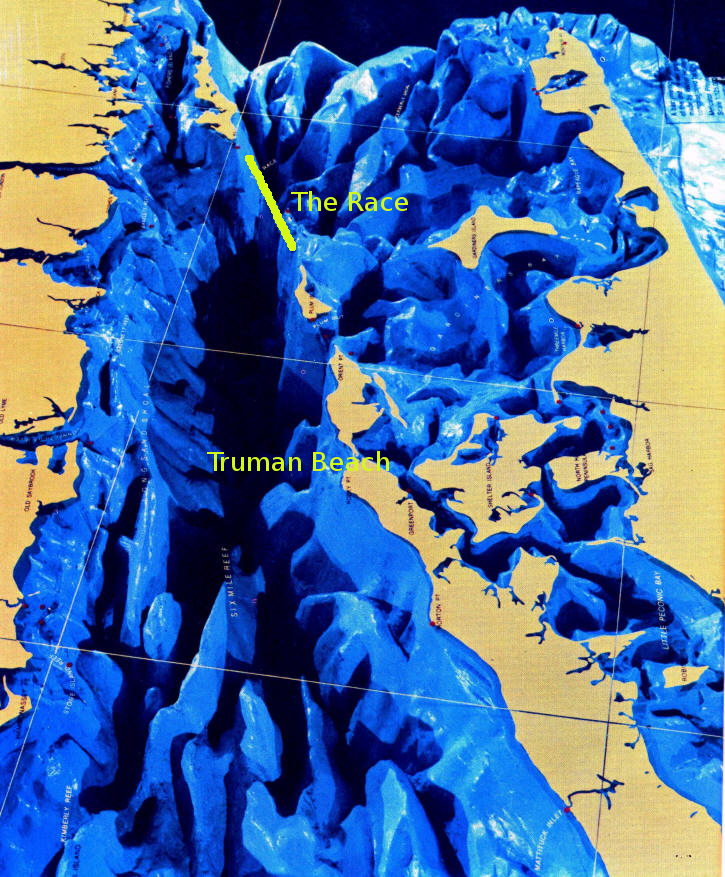
-- and found that I could get myself through The Race, the crazy tidal bottleneck at the mouth of Long Island Sound, on a vigorous ebbing current, if I got myself in gear quickly. Below, a diagram:

It's a little confusing -- east is up. The previous night's anchorage, Truman Beach, is labelled near the bottom. Click on the image to see more detail. All the water in the deep bits at the bottom of the image and beyond -- that is to say, to the west of the bottleneck, in the body of Long Island Sound -- has to empty out on the ebb through the small area shown with a line labelled "The Race". As you can see, it's narrow and relatively shallow, so the current gets quite strong.

I had had some trouble with The Race last year, coming home from Maine, and I didn't want any more. So I scrambled up on deck in my underwear and weighed anchor any old how and set out.

Eldridge was right, of course, as Eldridge always is. I went bounding through The Race like a bobsledder, wind on my port quarter, sun sparkling on the water, as sweet as you please, past Plum Island and Gull Island Light and Fisher's Island, and after a pleasant uneventful day I dropped anchor in a long slow purple twilight inside the Point Judith Harbor of Refuge.

Zoom out, as usual, to see the larger context.

How I love that phrase, Harbor of Refuge. Duncan, Duncan, Fenn and Fenn's famous Cruising Guide takes a dim view of this particular Harbor of Refuge -- a view which on the return trip I was to find justified -- but on this occasion it couldn't have been nicer.

The breakwater, admittedly, was lined with huddled seabirds, black against the dimming sky, and they had a sinister look, like ill-disposed jurymen contemplating an obviously guilty defendant. But there were a dozen other sailboats already anchored inside, their cheery little anchor lights lit at masthead or spreader, and this always gives me a good feeling.

I boiled and ate the last of my fresh eggs, drank a glass or two or six of wine, and went to sleep. The Harbor of Refuge lived up to its name, and I slept like the proverbial baby -- though come to think of it, babies in my experience don't sleep all that well. Wonder who came up with that expression?